AI avatar platforms have become one of the fastest-growing segments in digital content creation, and Zoice has emerged as one of the most talked-about tools in that space during 2026. As creators and businesses move away from traditional video production workflows, platforms that combine avatar generation, lip sync, automation, and voice synthesis into a single ecosystem are attracting significant attention. Zoice positions itself as a comprehensive AI content studio rather than a single-purpose avatar tool, aiming to simplify everything from scripting to final video generation.
The rise of AI-generated media has changed how online communication is produced and consumed. Instead of filming multiple takes, editing manually, or managing separate software for visuals and voiceovers, users increasingly expect one platform to handle the entire workflow. This is where Zoice attempts to differentiate itself. Rather than focusing solely on talking avatars, it combines multiple AI systems together to reduce production time and improve scalability for creators, agencies, educators, and brands.
However, the growing popularity of AI avatar platforms has also created a crowded market. Users no longer choose tools based only on novelty or basic animation capability. They now compare realism, rendering consistency, workflow flexibility, pricing transparency, and output quality. This Zoice Review explores how the platform performs across these areas, where it stands compared to competitors, and whether it truly deserves the attention it has received in 2026.
Key Takeaways
- Zoice combines avatar generation, lip sync, voice synthesis, automation, and AI-assisted workflows inside a single platform.
- The platform focuses heavily on realism, motion quality, and scalable content production.
- Its integrated workflow reduces dependence on separate editing and production tools.
- Zoice supports high-resolution exports and multilingual communication workflows.
- Motion control and character-swapping features provide more creative flexibility than many competitors.
- The platform is designed for both beginners and advanced creators managing large publishing schedules.
- Competitive pricing and scalable plans make it accessible for creators, educators, agencies, and businesses.
What Is Zoice?
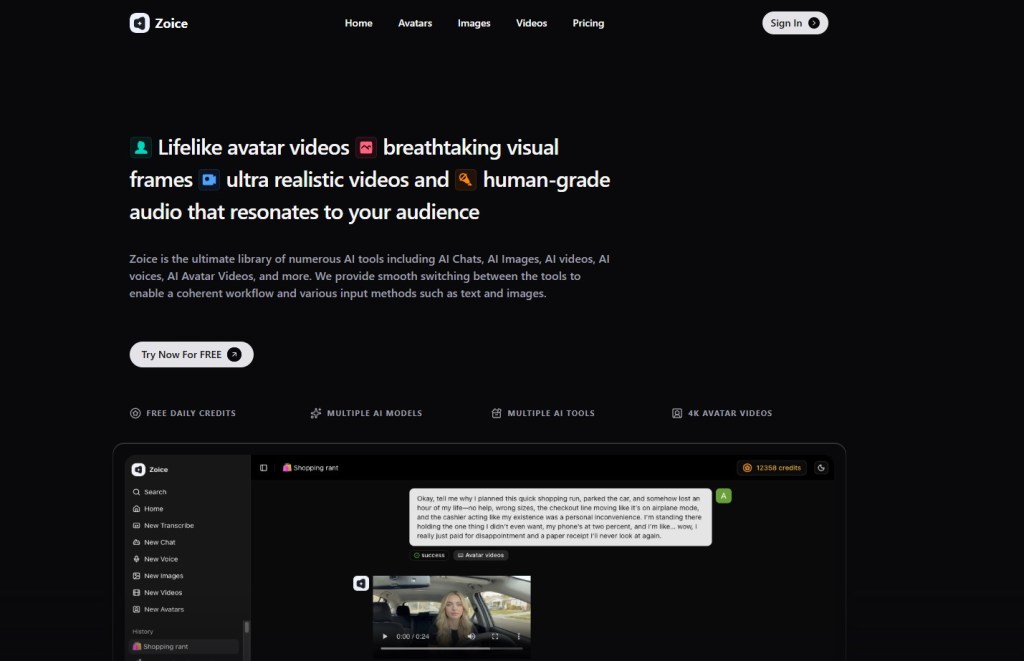
Zoice is an AI-powered video creation platform built around the concept of automated digital production. Instead of requiring cameras, actors, editing suites, or voice recording equipment, the platform enables users to generate complete videos through AI-generated avatars, synchronized voiceovers, and automated workflows.
At its core, Zoice is designed to reduce friction inside the content creation process. Users can generate scripts, create avatars, produce narration, apply lip synchronization, and export finished videos without constantly switching between separate tools. This unified workflow is one of the platform’s biggest advantages, especially for creators producing content frequently across multiple platforms.
What makes Zoice particularly notable is its attempt to balance accessibility with advanced functionality. Many AI tools simplify workflows but sacrifice realism or customization in the process. Zoice instead focuses on maintaining high visual quality while still offering approachable controls for users without professional editing experience.
Another defining aspect of the platform is scalability. Zoice is not limited to one type of creator or industry. It is increasingly used for social media videos, educational explainers, onboarding materials, AI-driven marketing campaigns, faceless YouTube channels, and multilingual communication projects. This versatility has helped position it as more than just a niche avatar generator.
The platform also reflects a broader shift in how content is produced in 2026. AI tools are no longer standalone experiments—they are becoming integrated production environments capable of replacing multiple traditional workflows simultaneously. Zoice fits directly into this transition by combining generation, automation, and rendering inside a single ecosystem.
Key Features of Zoice
AI Avatar Creation
Zoice includes a sophisticated avatar creation system capable of generating realistic digital presenters for multiple use cases. Users can create avatars tailored for educational videos, marketing campaigns, branded communication, or social media storytelling while maintaining a visually polished appearance.
One of the strongest aspects of the avatar system is consistency. Facial proportions, expressions, and rendering quality remain stable across multiple exports, which is especially important for creators building recurring digital identities. This continuity helps audiences recognize and trust AI-generated presenters over time.
The platform also offers customization flexibility. Users can modify visual styles, clothing, backgrounds, and presentation tone without rebuilding entire projects from scratch. This makes the avatar workflow adaptable for both professional and creative applications.
Character Swap and Motion Control
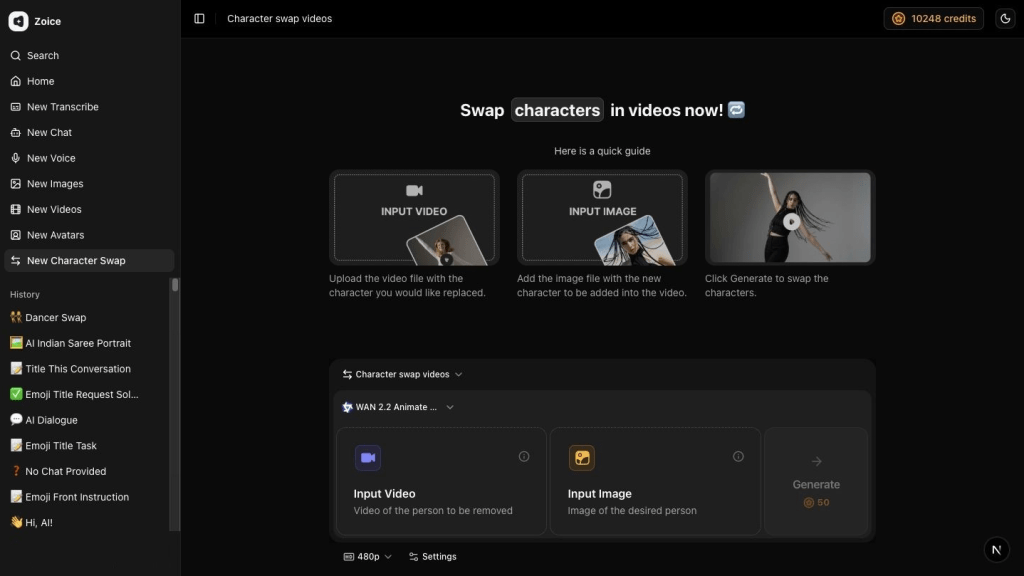
Character swapping is one of Zoice’s more unique features compared to many competing avatar platforms. Instead of recreating projects manually, users can replace characters while preserving scene structure and timing. This allows creators to repurpose content quickly for different audiences or branding requirements.
Motion control adds another layer of flexibility. Zoice allows users to adjust movement behavior dynamically rather than relying on rigid preset animation loops. This improves realism while also making communication appear less robotic during longer dialogue sequences.
The combination of motion control and character-swapping is particularly useful for marketing teams and agencies. Campaigns can be localized or personalized without requiring complete re-production, which dramatically improves scalability for high-volume content environments.
Advanced Lip Sync Technology
Lip synchronization is one of the most critical areas in AI-generated communication, and Zoice performs particularly well here. The platform maps speech patterns to facial articulation with strong timing accuracy, helping avatars appear more natural during dialogue delivery.
What separates Zoice from many lightweight competitors is that synchronization extends beyond the mouth itself. The system integrates blinking, expression shifts, and facial tension changes into speech-driven motion, creating a more cohesive visual performance overall.
This attention to synchronized behavior significantly improves viewer perception. Even subtle delays or unnatural articulation can break immersion, especially in long-form content. Zoice minimizes these issues effectively, making it suitable for professional communication workflows.
Integrated AI Tools and Automation
Zoice also expands beyond avatar generation by integrating AI-assisted workflows directly into the platform. Users can generate scripts, create supporting visuals, transcribe content, and automate parts of the production process without relying on additional software.
This integration simplifies workflow management considerably. Instead of moving between separate writing tools, editing suites, and image generators, users can handle multiple production stages inside one environment. This improves efficiency while reducing friction for smaller teams and solo creators.
Automation features also help scale content production. AI-assisted templates and workflow suggestions allow users to create recurring content formats faster, making the platform especially useful for creators publishing regularly across multiple channels.
Zoice Pricing and Plans
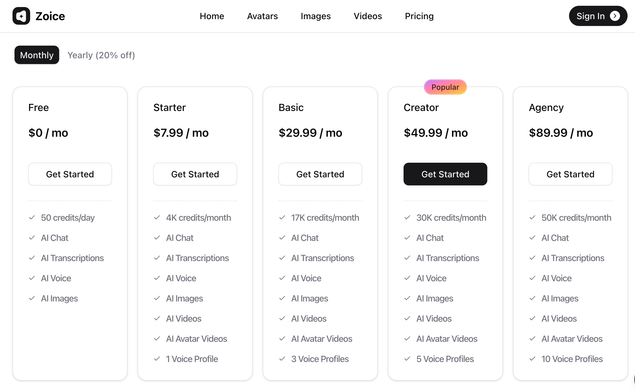
Zoice follows a scalable pricing structure designed to accommodate both casual creators and high-volume production teams. Instead of forcing users into expensive enterprise plans immediately, the platform offers entry-level access through flexible subscriptions and free credits.
This approach is important because many competing AI avatar tools become expensive quickly once users require higher-resolution rendering or advanced features. Zoice attempts to balance affordability with functionality, allowing users to scale gradually depending on production needs.
Transparency is another strength of the Zoice’s pricing system. Usage limits, export quality, and feature access are relatively straightforward compared to platforms that gate essential functionality behind multiple upgrade layers. This predictability makes budgeting easier for creators and businesses managing recurring content production.
Output Quality
Output quality is one of Zoice’s strongest areas overall. The platform supports rendering up to 4K resolution while maintaining strong consistency across lower export settings as well. Videos remain visually stable regardless of whether users choose lightweight social exports or high-resolution professional outputs.
Facial rendering quality is particularly impressive in repeated production scenarios. Avatars maintain recognizable structure and stable motion behavior even across multiple projects, which is critical for long-term branding and recurring digital communication.
Another important factor is motion realism. Instead of relying on exaggerated animation patterns, Zoice focuses on subtle behavioral details such as blinking, expression timing, and natural articulation flow. This improves immersion and helps videos feel less artificial overall.
Zoice Pros and Cons
| Pros | Cons |
|---|---|
| Strong lip sync accuracy and realistic facial behavior | 4K rendering can increase processing time |
| Integrated workflow reduces need for external tools | Advanced features may require learning time |
| Motion control and character swap flexibility | Internet-based workflow may affect rendering speed |
| High-resolution export support | Premium plans still required for heavy production |
| Scalable pricing and multilingual capabilities | Some customization options remain template-driven |
Zoice vs Other AI Avatar Tools
Compared to Synthesia, Zoice offers greater flexibility in motion control and avatar adaptation. While Synthesia remains highly structured for enterprise communication, Zoice provides a more creative and dynamic workflow environment.
Against HeyGen, Zoice positions itself as a broader production ecosystem rather than primarily a presentation-focused platform. The inclusion of automation, image generation, and character-swapping gives it a wider creative range for creators producing varied content types.
Compared to D-ID, Zoice delivers a more complete production environment rather than focusing narrowly on talking-head animation. D-ID performs well for lightweight communication videos, but Zoice expands functionality into scalable multi-purpose video generation workflows.
Who Should Use Zoice?
Zoice is particularly useful for creators who need recurring content production without constant filming. Faceless YouTube channels, social media creators, and digital educators benefit significantly from the platform’s automation and scalability features.
Marketing teams and agencies also gain advantages from Zoice’s reusable workflows. Character swapping, multilingual support, and high-volume rendering help reduce production costs while maintaining visual consistency across campaigns.
The platform is also suitable for entrepreneurs and startups building digital-first brands. Instead of investing heavily in traditional production infrastructure, businesses can generate polished AI-driven communication through scalable workflows that adapt to growing content demands.
Conclusion
Zoice has established itself as one of the most versatile AI avatar and video generation platforms available in 2026. By combining avatar creation, synchronization, automation, voice synthesis, and scalable workflows inside one ecosystem, it reduces many of the production barriers traditionally associated with video creation.
The platform’s biggest strengths lie in realism, workflow efficiency, and adaptability. Instead of functioning as a single-purpose animation tool, Zoice operates more like an AI-powered production environment capable of supporting creators, educators, agencies, and businesses across multiple content formats.
While no platform is perfect for every use case, Zoice currently offers one of the strongest overall balances between affordability, scalability, visual quality, and integrated functionality. For users seeking an efficient way to create AI-powered video content without traditional production complexity, it remains one of the most compelling options available today.
FAQs
What is Zoice used for?
Zoice is used for creating AI avatars, generating videos, producing voiceovers, and automating content creation workflows.
Does Zoice support high-resolution exports?
Yes, the platform supports video rendering up to 4K resolution.
Is Zoice suitable for beginners?
The platform is designed with approachable workflows that make it accessible even for users without professional editing experience.
How does Zoice compare to other AI avatar tools?
Zoice stands out because it combines avatar generation, motion control, automation, and integrated AI workflows inside a single platform.
Who benefits most from Zoice?
Content creators, marketers, educators, agencies, and businesses looking to scale video production efficiently can benefit significantly from the platform.


Leave a Reply